
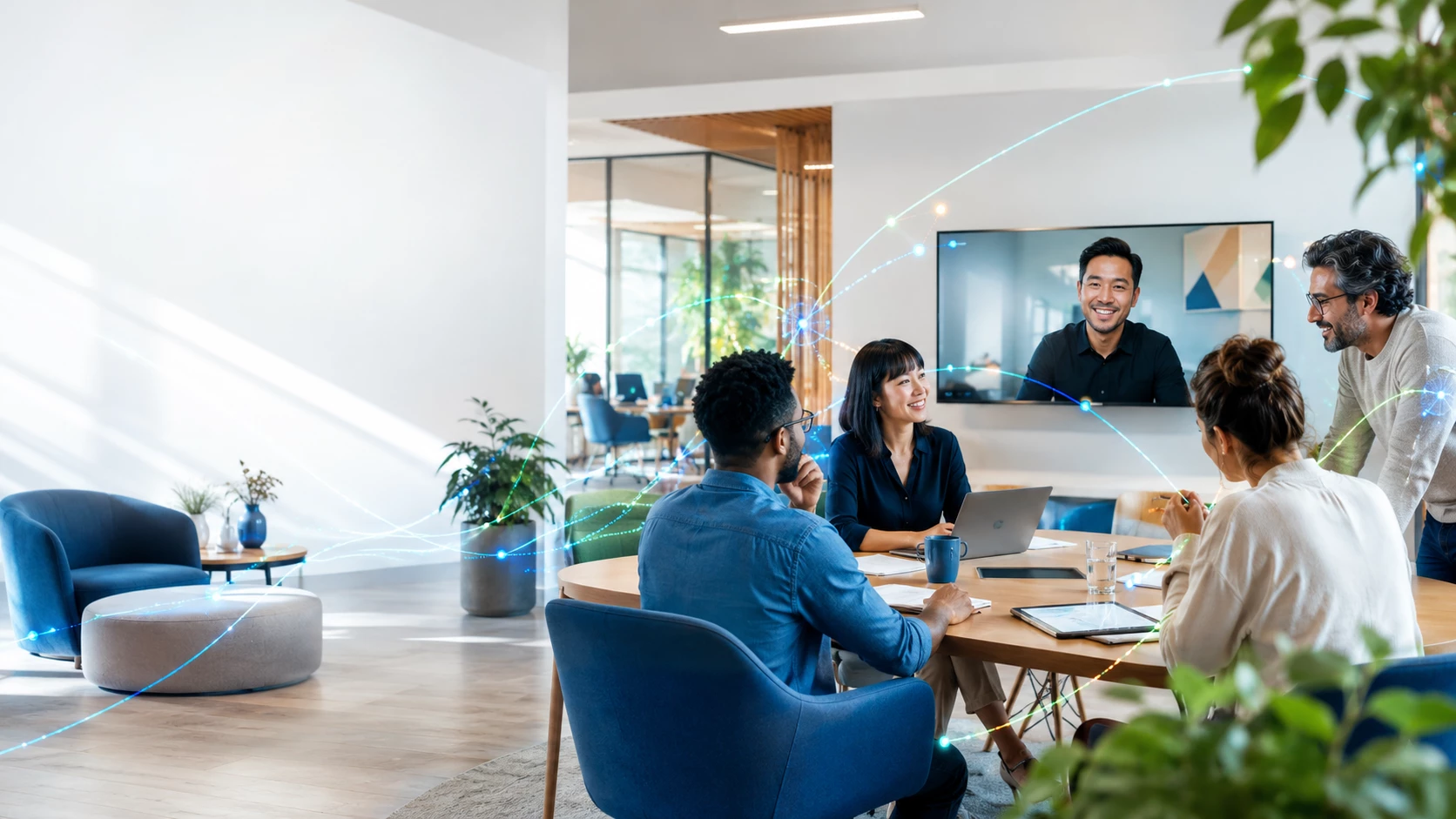

The workplace hasn’t simply changed location, it has changed shape.
Work now happens across offices, homes, factory floors, retail locations, and digital channels. AI is changing how employees find information and complete everyday tasks. Hybrid work has made flexibility an expectation, and organizations are working to preserve something technology alone cannot create: a strong, connected culture.
These forces are colliding, and they're transforming the role of the intranet.
Once a place to publish news and policies, the intranet has become the connective layer of the workplace. It brings people, information, communications, spaces, and AI-assisted experiences together. For those managing an intranet or curating essential knowledge and communications, this is an opportunity to rethink not only how information is shared, but how work itself feels.
Work is everywhere. The employee experience must be, too.
Hybrid work has given employees more choice, but flexibility can also create fragmentation.
Remote employees may experience the organization through a laptop and collaboration tools. Office-based employees move between meeting rooms, workplace screens, and face-to-face conversations. Frontline employees may rely on a mobile device or digital signage for information others receive by email.
Different environments should not mean different levels of access, awareness, or belonging.
Yet many organizations still struggle to connect their physical and digital workplaces. According to the Appspace 2026 Workplace Experience Trends & Insights Report:
-
55% of employees say their organization struggles to bridge the physical and digital workplace.
-
72% have felt out of the loop on important updates.
-
81% say communication is inconsistent across channels.
This is no longer only a communications problem, It is a workplace experience problem.
The intranet can help by creating a dependable source of truth and extending it across the channels employees actually use, from desktop and mobile to messaging platforms and workplace screens. The goal is not to make everyone work the same way, it's to give everyone an equitable path to the information, people, and resources they need.
AI turns the intranet into an assistant
For years, employees have been told to “go to the intranet” to find an answer.
AI changes that expectation.
Employees increasingly want to ask a question in natural language and receive a useful, relevant response. They want information summarized, content translated, and routine tasks simplified. They expect workplace technology to understand context and help them take the next step, not simply return a list of links.
Imagine an employee asking:
-
What changed in our travel policy?
-
Which office will my team be in tomorrow?
-
Where can I find the latest benefits information?
-
Is there an available desk near my project group?
-
What company updates did I miss while I was away?
Answering these questions well takes more than an AI interface. It requires accurate content, connected systems, appropriate permissions, and trusted governance.
That is why the intranet matters more in the age of AI, not less. It provides the structured, governed knowledge AI needs to deliver reliable answers. The goal is not to add AI for its own sake, but to remove friction from the moments that shape an employee’s day.
Culture lives across physical and digital spaces
Culture was never confined to an office, but office routines once reinforced it almost automatically, through hallway conversations, shared rituals, visible leadership, and informal interactions.
In a hybrid workplace, those moments are less predictable. Culture must become more intentional.
That does not mean filling every channel with more content. It means helping employees understand the organization’s priorities, understand how their work contributes, recognize colleagues, and participate in a shared experience wherever they are.
The intranet can turn culture into something employees encounter and contribute to every day. Leadership communications, employee stories, recognition, communities, and local updates create a living expression of the organization, not simply a static statement of its values.
Physical workplace experiences matter, too. Digital signage, workspace reservations, visitor experiences, and workplace information should reinforce the same messages and sense of belonging as the digital environment.
Culture grows stronger when the workplace feels connected across every touchpoint.
A new mandate for workplace teams
As AI, hybrid work, and culture converge, the intranet can no longer operate as an isolated communications channel.
Creating a connected experience requires collaboration across internal communications, HR, IT, facilities, and workplace teams:
-
Internal communications brings clarity and consistency.
-
HR brings employee services, policies, and moments that matter.
-
IT provides integration, security, governance, and scale.
-
Facilities connects digital experiences with physical spaces.
-
Intranet teams bring these elements together.
The question is no longer, “How do we get more employees to visit the intranet?” A better question is, “How can the intranet make every employee’s workday easier, more connected, and more productive?”
That shift also changes how success is measured. Page views still matter, but organizations should also ask whether employees can find trusted information quickly, whether important messages reach every workforce segment, and whether people feel connected to the organization and one another.
Build for the reality of work
The future of work is already here. Employees are navigating hybrid schedules, experimenting with AI, moving between physical and digital environments, and expecting workplace technology to support them at every step.
The organizations that succeed will not be those that add the most tools. They will be those that create the clearest, most connected experience.
That means treating the intranet as more than a destination. It should be the trusted foundation for communication, knowledge, culture, and action, reaching employees wherever work happens and giving AI the context it needs to be genuinely useful.
Hybrid work provides flexibility. AI provides speed and intelligence. Culture provides meaning.
When all three come together in a connected workplace, employees do not just get a better intranet. They experience a better way to work.