




Somewhere in your organization, the answer already exists. It’s buried in an old Teams chat, tucked away in a SharePoint folder, attached to a long-forgotten email, or living exclusively inside the head of the one employee everyone depends on.
That’s the challenge facing knowledge management in today’s intranet. Organizations aren’t struggling because they lack information. They’re struggling because employees can’t consistently find the right information at the right time. Intranets were meant to solve this problem, but instead, many have become overcrowded repositories filled with outdated documents, duplicate content, unclear ownership, and search experiences that leave employees frustrated. Over time, people stop trusting the platform entirely. Rather than searching for answers, they default to asking colleagues directly or recreating work that already exists somewhere else.
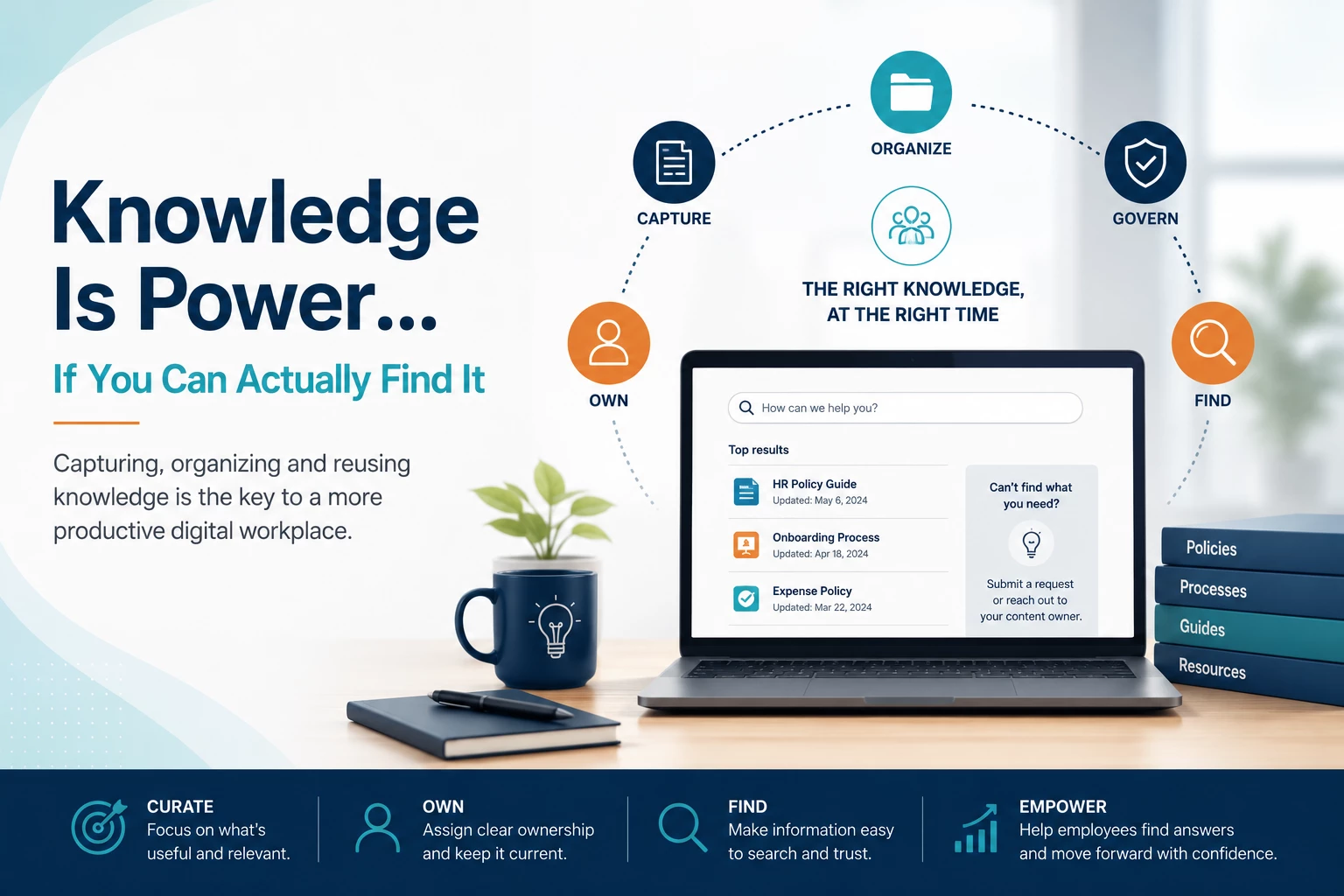
The issue isn’t simply technology. It’s structure. Too often, organizations focus on adding more content without establishing clear processes around how knowledge is organized, maintained, and surfaced. An intranet can only be effective if employees understand where information belongs, how it’s categorized, and whether it can be trusted. That’s why successful knowledge management starts with clarity and governance, not volume.
The strongest intranets create defined homes for important information and establish ownership around maintaining it. Employees shouldn’t have to guess whether a document is current or who is responsible for updating it. Clear content stewardship helps prevent our intranets from becoming digital graveyards full of expired resources and conflicting information.
Searchability is equally critical. Employees increasingly expect workplace search to function like consumer technology: fast, intuitive, and relevant. If search results consistently surface outdated or unrelated content, adoption suffers quickly. Strong metadata (labels, tags, etc.), consistent and identifiable naming conventions, and thoughtful information architecture play a far bigger role in knowledge management success than most organizations realize.
There’s also value in recognizing that not all knowledge deserves permanent visibility. One of the biggest contributors to intranet clutter is the instinct to preserve everything indefinitely. Effective knowledge management requires curation. Valuable, high-impact content should be easy to locate, clearly organized, and connected to the tasks employees perform every day. Content that is outdated or no longer adding value should be archived or deleted.
Perhaps most importantly, organizations need to simplify the process of contributing and maintaining knowledge. If publishing information feels overly complicated or ownership is unclear, content quickly becomes stale. Sustainable knowledge management depends on creating lightweight, repeatable processes that people will actually follow.
Ultimately, knowledge management isn’t about storing more information, it’s about reducing friction. When employees can quickly find accurate, trusted knowledge without navigating a maze of folders, outdated pages, and disconnected systems, the intranet becomes more than a repository. It becomes a genuine productivity tool.