
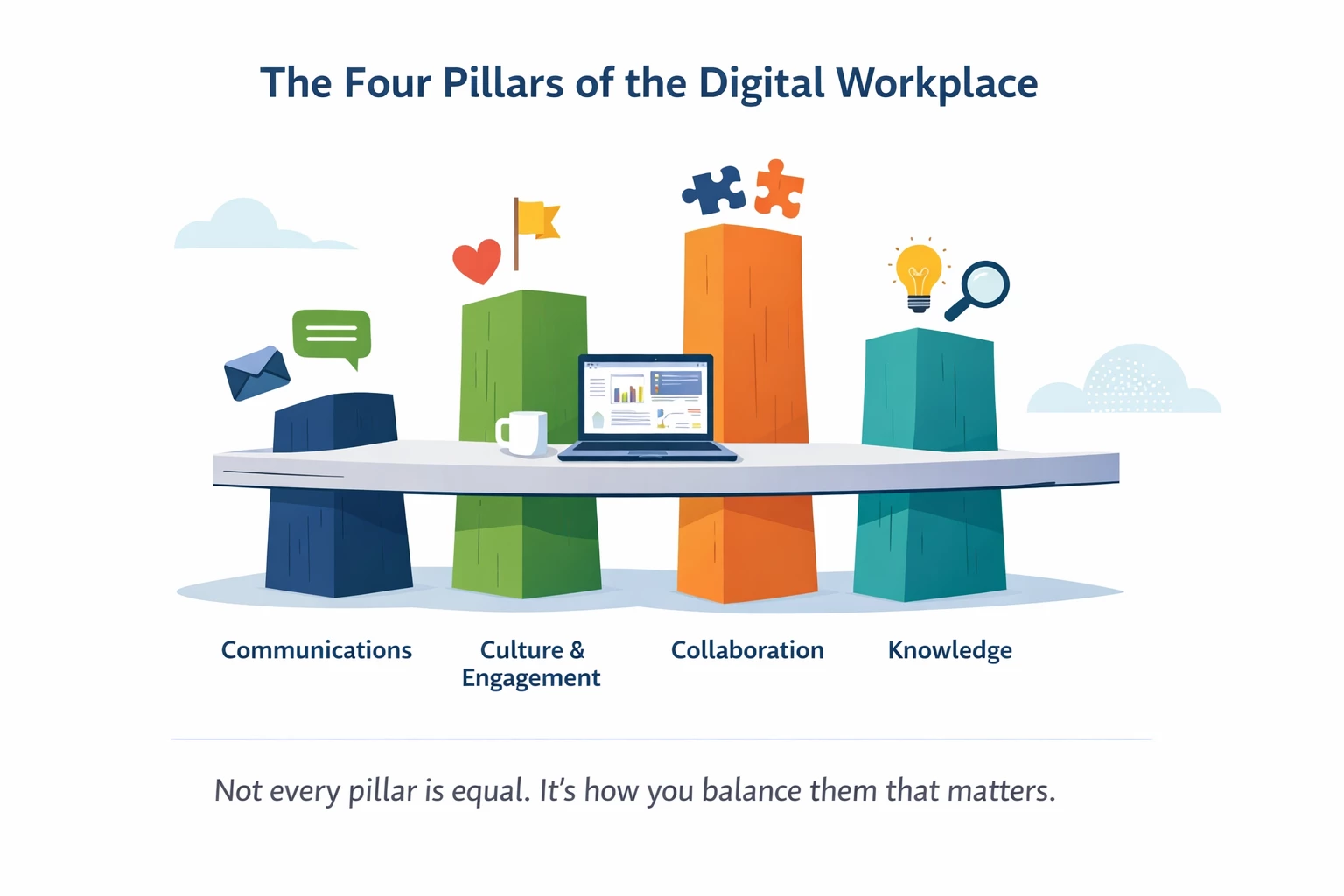




Digital workplaces are often described as being built on four pillars: communications, culture & engagement, collaboration, and knowledge management.
They’re typically presented as equally critical. In reality, most organizations succeed by emphasizing some pillars more than others. What matters isn’t whether all four are fully realized, it’s whether the trade-offs are understood and intentional.
Communications: The Non-Negotiable
Every organization needs a reliable way to communicate clearly and consistently. Employees need to know what’s happening, what’s changing, and what they’re expected to do.
While email and messaging tools play an important role, they’re inherently transient. A digital workplace provides continuity as a trusted place where information lives beyond the moment it’s shared. When this pillar is weak, communication doesn’t stop; it simply becomes fragmented and harder to rely on.
Culture & Engagement: A Strategic Choice
Culture doesn’t disappear if it isn’t designed for digitally, it simply becomes invisible.
Some organizations intentionally invest in storytelling, recognition, and social connection. Others focus their digital workplace on information and task completion. Both approaches can be effective, but they produce different employee experiences. Over time, those experiences influence alignment, trust, and retention.
Choosing not to invest in digital culture isn’t wrong, but it is a choice with consequences.
Collaboration: Where Work Happens, and Where It Lasts
Modern collaboration tools enable fast, real-time work. Conversations, decisions, and files often move through chat platforms first.
The digital workplace acts as a supportive backbone. It offers structure, context, and institutional memory, enabling teams to capture and reuse collaborative outcomes instead of letting them get lost in message threads. When thoughtfully designed, it minimizes duplication and maintains continuity without hindering productivity. Collaborative spaces or communities within the intranet can further enhance this value, complementing other collaboration tools.
Knowledge Management: The Long-Term Advantage
Knowledge management rarely feels urgent, but it becomes critical as organizations grow and change.
Without intentional knowledge practices, expertise becomes harder to find and key information easier to lose. Over time, this affects onboarding speed, decision making, and operational efficiency. Even modest investments in structure and ownership can significantly reduce these risks, ensuring that knowledge is accurately maintained and trust doesn't erode.
The Big Question
The most useful question isn’t “Do we use all four pillars?”
It’s “Which ones are we deliberately prioritizing, and are we comfortable with the trade-offs we’ve made?”
A successful digital workplace reflects how work actually happens today while preparing the organization for tomorrow. Clarity, not completeness, is what ultimately drives value.